
Sources said that even though India and China have been talking at the diplomatic and the military level for over six weeks now, there has been no thinning down in troop numbers or equipment by the Chinese side on this front.
Chinese Ambassador Sun Weidong said India and China are able to properly manage their differences, and called upon New Delhi to avoid taking actions that may 'complicate' the situation in eastern Ladakh.

Why can't the Indian government propose to the Chinese a corridor circumambulating the Holy Mountain where people from both sides could perform the yatra again? asks Claude Arpi.

The forward airbase near the PoK-China border, which from where Pakistan is around 50 kilometres and the strategic Daulat Beg Oldi is around 80 kilometres, the activity of fighter, transport aircraft and helicopters is going on during both day and night.

In the meeting, Doval conveyed to Wang that peace and tranquillity in border areas and respect for the Line of Actual Control are essential for return of normalcy in bilateral ties, according to the ministry of external affairs.

India and China have agreed to work towards a "roadmap" for rebuilding mutual trust following the border standoff in eastern Ladakh, according to a statement from the Indian Defence Ministry. Defence Minister Rajnath Singh met with his Chinese counterpart Dong Jun in Vientiane, Laos, on the sidelines of a regional security conclave. Singh called for drawing lessons from the "unfortunate border clashes" of 2020 and emphasized the need for cooperation rather than conflict. Both sides agreed to work towards a roadmap for rebuilding mutual trust and understanding, and a meeting of the Special Representatives and Secretary-Vice Minister mechanism will also take place soon.

Doval is in Beijing for the 23rd round of the Special Representatives' talks being held after a gap of five years.

'China will do everything to hamper our ability to be a competitor.' 'China wants every country in the region to be subservient and we are the biggest stumbling block.'

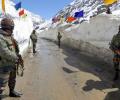
Chinese troops are reinforcing their posts in large numbers, increasing their patrolling, stepping up violations in the Tawang and Walong areas.

After the disengagement process is completed, the two armies are likely to hold further talks to take the process further.
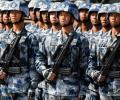
With the Indian Army having blocked the PLA several kilometres inside India, hundreds of soldiers from both sides remain in a tense face-off.

The Indian Army is one of the very few armies in the world that operates tanks at high altitudes up to 16,000 feet, and in large numbers.

Army chief General Naravane said the ongoing dialogue will sort out all the perceived differences between the two countries.
It is learnt that the India's top military brass is constantly monitoring the evolving situation even as the United States said the aggressive behaviour by Chinese troops was a reminder of the threat posed by China.
'Which will not happen.' 'Foreign Minister S Jaishankar has expressly refuted Beijing's statement that normalcy was returning to Sino-Indian relations.'

'The Chinese are retaining geostrategic pressure on India by keeping troops there and building infrastructure continually.'
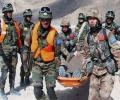
This is the first such incident along the border with China that Indian armed forces personnel have been killed after a gap of nearly 45 years.
'This reluctance to respond forcefully to Chinese PLA provocations and outright aggression has as much to do with Prime Minister Modi personally, as with the institutional mindset of the MEA or even the Indian Army.' 'They are scarred by the 1962 War and are still cowed by China.'

In its first official account of the standoff between the two militaries, the ITBP revealed how its troops "not only effectively used shield to protect themselves but also responded fiercely to advancing PLA (Chinese People's Liberation Army) troops and brought the situation under control". "The ITBP has recommended the names of 21 men who faced the Chinese during the face-offs and skirmishes in May-June this year for gallantry," it said.

India is set to press for early disengagement of troops from the remaining friction points in eastern Ladakh at a fresh round of high-level military talks with China on August 14, people familiar with the matter said on Saturday.
The MEA said it was the Chinese side that recently undertakook activities hindering India's normal patrols in the areas.

It is on the exact spot where the Guru is said to have created 108 waterfalls, that the Yangtse clash took place between the Indian Army and the Chinese PLA on the night of December 9, 2022. As it had done in Ladakh in May 2020, the PLA tried to change the unmarked LAC in the Yangtse sector in Arunachal Pradesh. It was the most serious border incident since the Galwan Valley clash in June 2020, notes Claude Arpi.

India and China made progress in five-six friction points along the Line of Actual Control in eastern Ladakh through talks in the last three years and efforts are underway to resolve the remaining issues, External Affairs Minister S Jaishankar said on Monday.

The puja is performed on the banks of river Sindhu (Indus).

Out of 18, four personnel were critically injured but they are responding to treatment and are stable now, people familiar with the matter said.
'We will not accept these misadventures by the Chinese.'
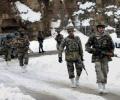
'The Indian Army's surveillance had noticed the Chinese movements.' 'There was no intelligence failure.'
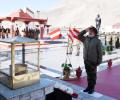
Lieutenant General Harinder Singh, who commands the 'Fire and Fury' 14 Corps, has the experience and talent to face down the Chinese challenge. The general is a rare combination of thinker and tough-minded doer, observes David Devadas.
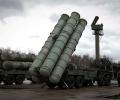
RInstead of disengagement, the Indian and Chinese armies have deployed an estimated 35,000 to 40,000 soldiers each along the LAC. The PLA has deployed S-400 air defence missiles to neutralise the IAF's advantage in air power

'India imports 70 per cent of its bulk drugs from China. Are we going to live without antibiotics?' asks Debashis Basu.
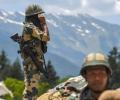
'I am ashamed we are dealing with such adversaries.'

Lauding the bravery displayed by the soldiers, the prime minister said: "The bravery that you and your compatriots showed, a message has gone to the world about India's strength."
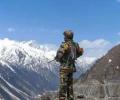
'China has forcibly occupied territory it had never occupied before, blocked Indian patrols' access to areas they had patrolled for decades and, most provocatively, killed 20 Indian soldiers.' 'Most countries would regard these as acts of war.' 'New Delhi has apparently taken off the table the option of evicting the PLA with force,' observes Ajai Shukla.

The capital cost of the entire project, including a 5.6-km-long bridge, other minor bridges, underpasses and a rail overbridge, was estimated at over Rs 2,900 crore. The decision to cancel the project came in the backdrop of the killing of 20 Indian soldiers in a clash with Chinese troops in eastern Ladakh's Galwan Valley on June 15.

'India has ramped up infrastructure on its side, so the Chinese military is finding Indian soldiers in locations where they are not used to seeing an Indian footprint,' points out Harsh V Pant.

"As regards reports about a bridge being made by the Chinese side on Pangong Lake, the government has been monitoring this activity closely," External Affairs Ministry Spokesperson Arindam Bagchi said.
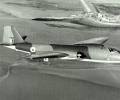
'If we had sent a few airplanes (into Tibet), we could have wiped the Chinese out.' 'And everything could have been different in the 1962 War.' 'They did not believe me there was no Chinese air force.' 'Can you imagine what would have happened if we had used the IAF at that time?' 'The Chinese would have never dared do anything down the line.'

'If you behave like a nail, the adversary will behave like a hammer.'
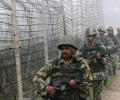
Most of India's reserves for war in the mountains have been sucked in by the standoff with China. A large part of India's airpower has also similarly been committed on the eastern border. By moving these reserves to the China border, India has been weakened vis-a-vis Pakistan. All in all, the nightmare scenario for India of a two-front war may well come true, warns Colonel Anil A Athale (retd).

The village in Maharashtra has continuously sent soldiers to the Army since World War I. Every other person you meet is a soldier or a retired soldier or is aspiring to be a soldier.
